As much as some of us loved or hated Entropy, I'm in the midst of writing a paper on the representations of gender through advertising in the 1950s, and so I decided to look up some (only some) of the multitude of pop culture references Pynchon imported for the story, which is supposed to take place in 1957. Here is some of what I found (click on the images for more info on each):
 "[Callisto's] had always been a vigorous, Italian sort of pessimism: like Machiavelli, he allowed the forces of virtu and fortuna to be about 50/50; but the equations introduced and random factor which pushed the odds to some unutterable and indeterminate ratio which he foundhimself afraid to calculate."
Machiavelli - Footnote: Niccolo Machiavelli (1469-1537), Forentine statesman and writer on government, contrasted virtuous behavior (virtu) with good luck (fortuna) (p. 2821).

"He was an ex-Hungarian freedom fighter who had easily the worst chronic case of what certain critics of the middle class have called Don Giovannism in the District of Columbia" (p. 2820).
Don Giovanni - An opera in two acts by Mozart. "Don Giovanni, a young nobleman, after a life of amorous conquests, meets defeat in three encounters. The first is with Donna Elvira, whom he has deserted but who still follows him. The second is with Donna Anna, who must postpone her marriage to Don Ottavio after Don Giovanni tries to rape her and kills her father, the Commendatore, escaping afterwards. The third is with Zerlina, whom he vainly tries to lure from her fiancé, the peasant Masetto. All vow vengeance on Don Giovanni and his terribly harassed servant Leporello. Elvira alone weakens in her resolution and attempts reconciliation in the hope that Giovanni will reform. Don Giovanni's destruction and deliverance to hell are effected by the cemetery statue of the Commendatore, who had accepted the libertine's invitation to supper" (Wikipedia).


"Soon Meatball said: 'It was something earthshattering, no doubt. Like who is better, Sal Mineo or Ricky Nelson.' "
Sal Mineo (L) and Ricky Nelson (R) - Footnote: Contemporary figures from film and television who were icons of bad and good teenage behavior respectively
(p. 2822).

Krinkles to one of the 'coeds,' "When Dave was in the army, just a private E-2, they sent him down to Oak Ridge on special duty. Something to do with the Manhattan Projec
t. He was handing hot stuff one say and got an overdose of radiation. So now he's got to wear lead gloves all the time."
The Manhattan Project - footnote: The research that developed the atomic bomb for the use at the end of World War II (p. 2823). In a national survey at the turn of the millennium, both journalists and the public ranked the dropping of the atomic bomb and the end of the Second World War as the top news stories of the twentieth-century (from: http://www.cfo.doe.gov/me70/manhattan/).
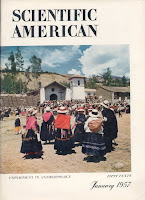
Saul to Meatball, " 'Miriam has been reading science fiction again. That and Scientific American. It seems she is, as we say, bugged at this idea of computers acting like people." (p.2822)
Scientific American Magazine - The oldest continuously published magazine in the U.S., has been bringing its readers unique insights about developments in science and technology for more than 160 years. (from http://www.scientificamerican.com/pressroom/aboutus-history.cfm)

"...And then this crew off the good ship Lollipop or whatever it was might to take it upon themselves to kick down the closet door, for a lark."
Good Ship Lollipop - Footnote: The subject of film and song popularized in the 1930s by the American child actress Shirley Temple (p. 2826). (Click on this image of Shirley Temple to specifically see the part of the film where she sings the song. I don't quite know what to make if it...)
Some of these references have come up more than once through our readings this semester (ie The Manhattan Project - in Postcards: the Uranium mines, Scientific American - in Elizabeth Bishop's "In the Waiting Room": comparable to National Geographic)
